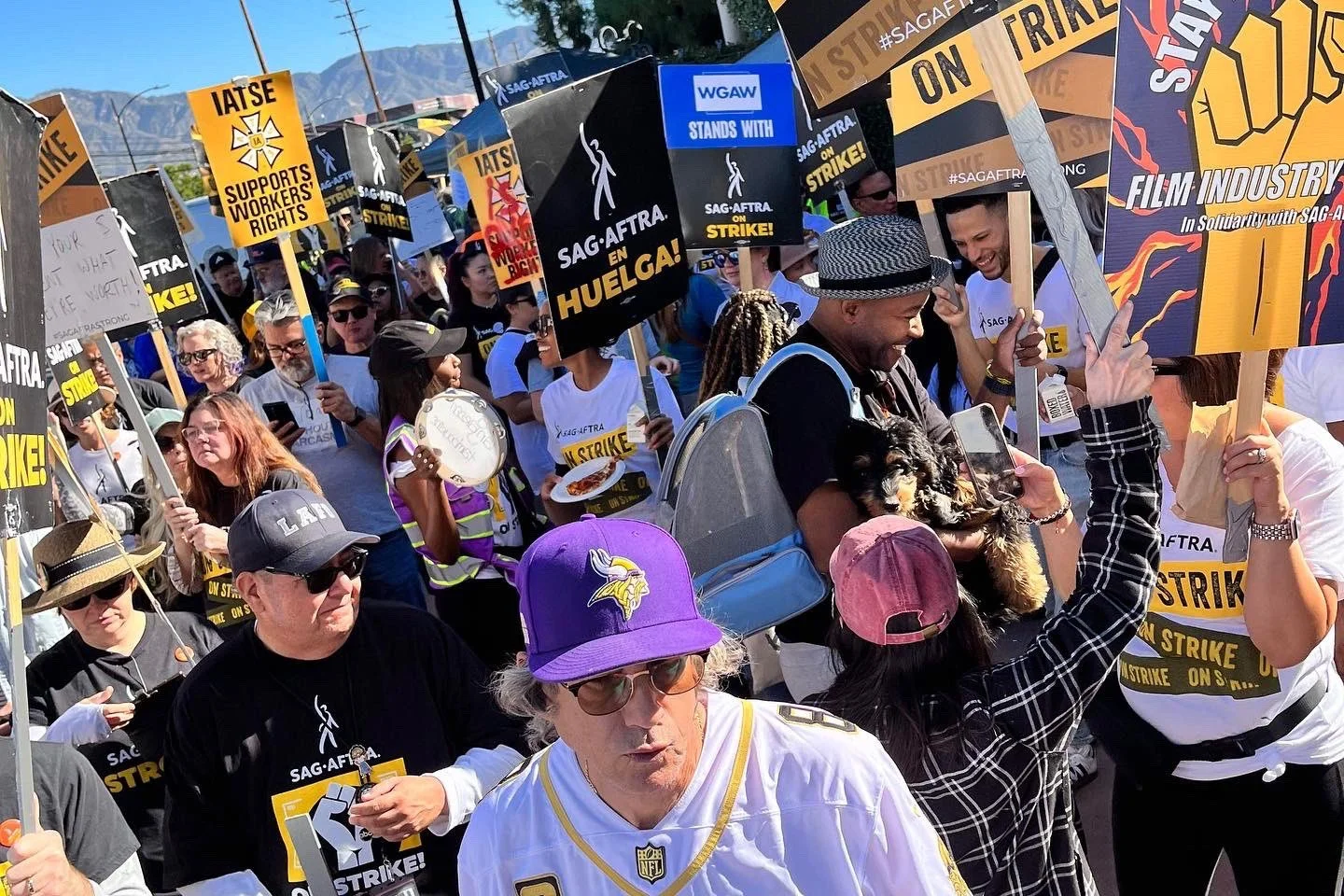


Less than two days before SAG-AFTRA members commence voting on approving their new agreement with the studios, the actors guild has unveiled a comprehensive summary of the potential three-year contract.
According to a source within the guild, the tentative agreement, reached with the AMPTP on November 8 after a 118-day strike, is perceived as a positive and fair deal. The guild's National Board, with an 86% approval rate on November 10, has now released expanded bullet points of the deal. Guild leaders, including president Fran Drescher and chief negotiator Duncan Crabtree-Ireland, will engage with members to present and address questions about the deal before the ratification voting starts on Tuesday. The first meeting is scheduled for Monday in an exclusive online session at 10 a.m. PT, with more gatherings planned before the ratification vote deadline in early December.
While the detailed 128-page Memorandum of Agreement, outlining the estimated $1 billion deal, is not yet available and may take weeks to be released, some critics are already expressing concerns. They argue that the guild's negotiating committee did not sufficiently press for AI protections and success-based bonuses for streaming content during discussions with the CEO Gang of Four and the AMPTP. The guild initially proposed a 2% revenue-sharing plan, which later reduced to 1% and then to a 59¢ subscriber "levy." The final outcome is an annual $40 million fund or $120 million over the three-year contract.
As stated in the current summary, the jointly trusteed fund for a "success payment" on streaming projects, applicable to those exhibited on or after January 1, 2024, seems less groundbreaking than initially suggested. The 75/25 distribution model of the allocated money lacks specific numbers for the streaming bonuses, and details about conditions are left unspecified. The summary notes that 75% will directly go to the cast of a successful streaming show or movie, with the remaining 25% allocated to the guild and studio co-run fund. Distribution guidelines for the fund remain undetermined.
The noteworthy aspect distinguishing this deal from the WGA's agreement is that 25% of the discretionary fund can be allocated to any SAG-AFTRA members chosen by the trustees, irrespective of their involvement in a hit streaming show. This discretionary portion could potentially benefit financially struggling guild members, around 85% of whom do not meet the annual income requirement for healthcare and other benefits.
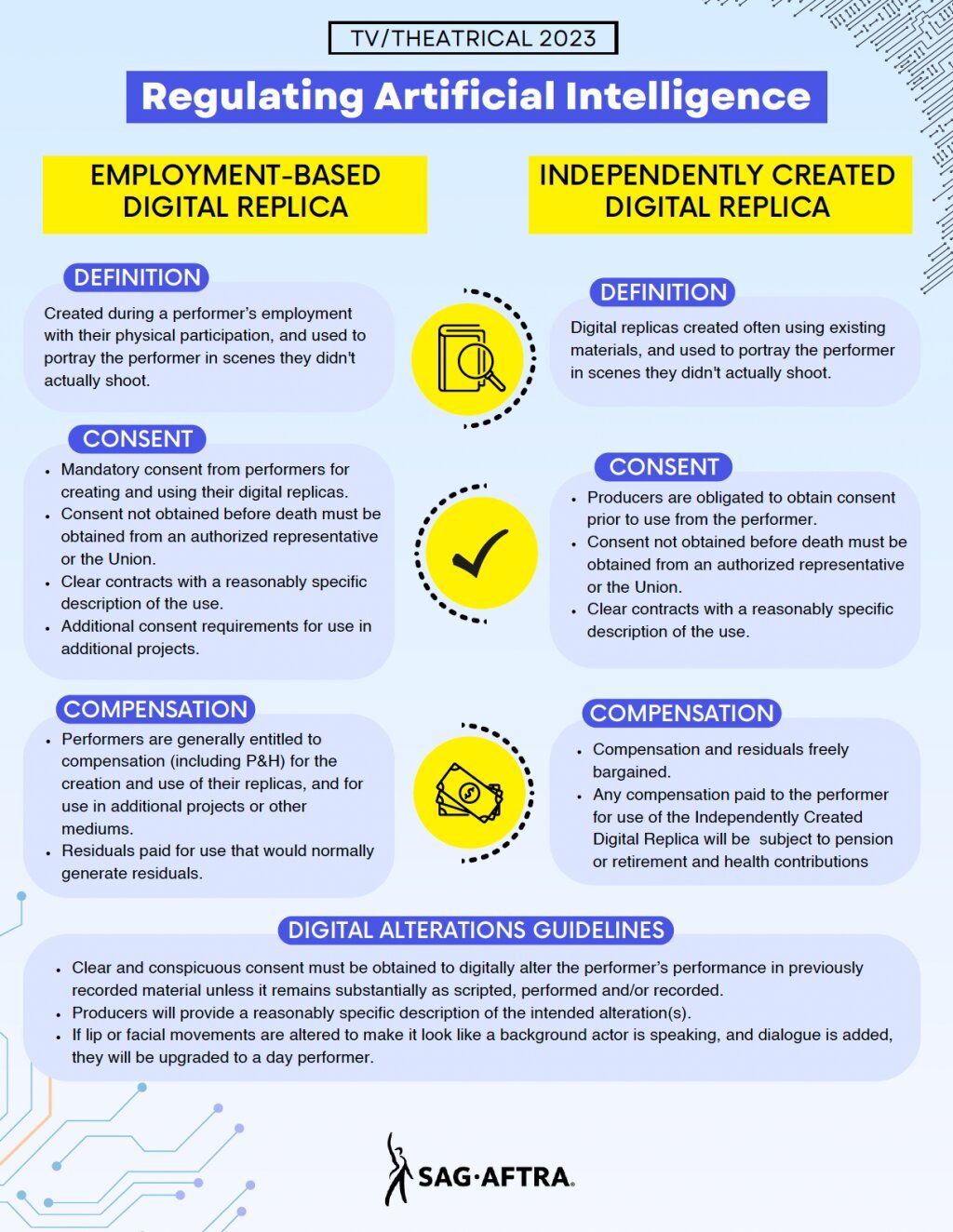
In terms of AI protection provisions, the 18-page summary's exceptions to consent section raises concerns due to its broad caveats. The summary suggests that studios and producers do not need performers' consent for AI use in post-production alterations, editing, arranging, rearranging, or other purposes related to cosmetics, wardrobe, noise reduction, timing, continuity, pitch, tone, clarity, visual/sound effects, filters, standards and practices, ratings, dialogue or narration adjustments, or similar purposes. The summary also highlights the inclusion of graphic explanations of new AI guardrails, prompting questions about what is excluded from the deal.
Deal Summary

Summary of 2023 Tentative Successor Agreement to the 2020 Producer-SAG-AFTRA Codified Basic Agreement (‘Codified Basic Agreement’) and 2020 SAG-AFTRA Television Agreement (‘Television Agreement’)
I. SCOPE, TERM, AND WAGES
A. The following terms describe the tentative agreement reached for successor agreements to the 2020 Producer-SAG-AFTRA Codified Basic Agreement (“Codified Basic Agreement”) and 2020 SAG-AFTRA Television Agreement (“Television Agreement”) (hereafter, collectively “the Agreements”). The Agreements cover theatrical motion pictures and scripted dramatic content produced for television and new media platforms.
B. The successor agreements go into effect on Nov. 9, 2023 and continue through June 30, 2026. Except as otherwise provided, wages and economic terms go into effect on Nov. 9, 2023 and working conditions terms go into effect the Sunday after notice of ratification to the Alliance of Motion Picture and Television Producers(“AMPTP”), which is the multi-employer bargaining association that represents the major studios in negotiations with SAG-AFTRA.
C. Minimums shall increase by 7% effective Nov. 9, 2023, by another 4% effective July 1, 2024 and by another 3.5% effective July 1, 2025. These increases shall be compounded. Except as specifically noted, there are no increases to penalties or allowances.
II. ARTIFICIAL INTELLIGENCE
A. Effective Date: The below terms will apply beginning 90 days after the AMPTP receives notice of ratification, except that to the extent practicable, Producers shall endeavor to comply with these provisions on or after the first day of the term of this Agreement, i.e., Nov. 9, 2023.
B. Digital Replication and Alteration of Performers
1. Establishes definitions and coverage for creation, use, and alteration of “digital replicas” of performers
a) Creation and use of two types of digital replicas: ‘Employment-Based Digital Replica’ and ‘Independently- Created Digital Replica’
2. Employment-Based Digital Replica: A replica of the voice or likeness of the performer that is created: (i) in connection with employment on a motion picture under this Agreement; (ii) using digital technology; (iii) with the performer’s physical participation; and (iv) is for the purpose of portraying the performer in photography or sound track in which the performer did not actually perform.
a) Services for creation of Employment-Based Digital Replica:
(1) 48-hour advance notice prior to services for creation
(2) Consent required
(a) Must be clear and conspicuous
(b) An endorsement or statement in the performer’s employment contract that is separately signed
or initialed by the performer or in a separate writing that is signed by the performer
(c) Time spent creating replica is work time if on the same day that the performer performs other
work for the producer
(3) Compensation for services on a day the performer is not performing other work for the producer:
(a) One (1) day at performer’s pro rata daily salary, but not less than day performer minimum
(b) If the work was scheduled on a separate day in order to accommodate performer, one half ( ) of the performer’s pro rata daily salary is due for a four (4) hour session. Over four (4) hours, one
(1) day at the performer’s pro rata daily salary (not less than the day performer minimum)
(c) Consecutive employment does not apply
(d) No additional pay if:
(i) Performer employed under Schedule F
(ii) Work occurs during the performer’s guarantee
(iii) Work occurs on a day that Producer is paying a minimum of 1 day’s salary for other services, travel allowance, or consecutive employment
b) Use of Employment-Based Digital Replica:
(1) In the motion picture for which the performer was employed
(a) Consent required unless the photography or sound track remains substantially as scripted, performed and/or recorded
(b) Must include a reasonably specific description of the intended use
(c) Consent must be clear and conspicuous and may be obtained through an endorsement or statement in the performer’s employment contract that is separately signed or initialed by the performer or in a separate writing that is signed by the performer
(d) Consent granted during a performer’s lifetime continues after death unless explicitly limited otherwise
(i) If performer is deceased and consent is required, it may be granted by an authorized representative of the deceased performer or, if representative cannot be found, by the union
(e) Compensation:
(i) Performer’s pro rata daily rate or the minimum rate, whichever is higher, for the number of production days that Producer determines the performer would have been required to work had the performer instead performed those scene(s) in person. Producer must make a good faith effort to estimate the number of production days utilizing objective criteria
(ii) Compensation treated as wages for all purposes
(iii) No compensation required if:
(a) Based on the performer’s form of engagement, their compensation would have covered the work had it been performed by the performer
(b) The digital replica is used in a scene in which the performer performed in person
(c) Performer is under Schedule F
(f) Residuals required if digital replica remains in the motion picture in a manner that would have entitled the performer to residuals
(i) Time-and-salary units, ‘total applicable minimum’ or ‘total actual compensation’ formula residuals based on the total time worked and/or salary paid, up to caps, for both in-person services and use of the digital replica
(ii) Rateable distribution formula — based on the performer’s form of engagement, unless only the digital replica remains. If so, performer is treated as a day performer and assigned one (1) unit.
(2) Use Other Than in the Motion Picture for Which the Performer Was Employed
(a) Consent and separate bargaining
(i) Consent must be clear and conspicuous
(ii) Must include a reasonably specific description of the intended use
(iii) Consent at time of use, not initial employment, except that consent for use in another identified project may be obtained at initial employment, provided that:
(a) a reasonably specific description of the intended use is provided for each identified project
(b) performer is also employed in the other identified project(s) or is deceased at the time the other identified project(s) commences production
(c) Consent continues after death unless explicitly limited otherwise
(d) If performer is deceased and consent is required, it may be granted by an authorized representative of the deceased performer or, if representative cannot be found, by the union
(b) Compensation:
(i) Day performer rate (including residuals as applicable) is minimum
(ii) Use in a field or medium covered by another SAG-AFTRA collective bargaining agreement subject to bargaining at no less than the minimum wages and residuals in that agreement
(iii) No additional compensation required for use if performer was employed under Schedule F
3. Independently Created Digital Replica: (i) intended to create, and does create, the clear impression that the asset is a natural performer whose voice and/or likeness is recognizable as the voice and/or likeness of an identifiable natural performer; (ii) performing in the role of a character (and not as the natural performer himself/herself); and (iii) no employment arrangement for the motion picture in which the Independently Created Digital Replica will be used exists with the natural performer in the role being portrayed by the asset.
a) Consent and bargaining required prior to use
b) Consent must be clear and conspicuous
c) Signed by performer in a writing that includes a reasonably specific description of the intended use
d) Continues after death unless explicitly limited otherwise
e) If performer is deceased, may be granted by the authorized representative of the deceased performer or the union if representative cannot be found
f) P&H contributions required
g) Exceptions for uses if they would be protected by the First Amendment (e.g., comment, criticism, scholarship, satire or parody, use in a docudrama, or historical or biographical work, to the extent protected by the First Amendment.)
4. Digital Alteration
a) Consent required to digitally alter a performer’s performance in photography or sound track previously recorded by the performer
b) Exception when the photography or sound track of the performer remains substantially as scripted, performed and/or recorded
c) Consent must be clear and conspicuous and may be obtained through an endorsement or statement in the performer’s employment contract that is separately signed or initialed by the performer or in a separate writing that is signed by the performer
d) Must include a reasonably specific description of the intended alteration
e) Continues after death unless explicitly limited otherwise
(1) If performer is deceased, consent may be obtained from authorized representative or union if representative cannot be found
f) Exceptions to consent:
(1) Post-production alterations, editing, arranging, rearranging, revising or manipulating of photography and/or sound track for purposes of cosmetics, wardrobe, noise reduction, timing or speed, continuity, pitch or tone, clarity, addition of visual/sound effects or filters, standards and practices, ratings, an adjustment in dialogue or narration or other similar purposes
(2) Under any circumstance when dubbing or use of a double is permitted under the Codified Basic Agreement or Television Agreement
(3) Adjusting lip and/or other facial or body movement and/or the voice of the performer to a foreign language, or for purposes of changes to dialogue or photography necessary for license or sale to a particular market
g) Claims subject to arbitration
h) Remedies limited to monetary damages
5. Does not expand or contract existing rights under CBA or TV Agreement
a) No impact on Section 43 of the General Provisions (nudity)
C. Generative Artificial Intelligence
1. Establishes a broad, protective definition of “generative artificial intelligence”
2. Establishes terms for use of “Synthetic Performers” created through Generative Artificial Intelligence
a) A ‘Synthetic Performer’ is a digitally-created asset that: (1) is intended to create, and does create, the clear impression that the asset is a natural performer who is not recognizable as any identifiable natura performer; (2) is not voiced by a natural person; (3) is not a Digital Replica ; and (4) no employment arrangement for the motion picture exists with a natural performer in the role being portrayed by the asset.
(1) Parties acknowledge the importance of human performance in motion pictures and the potential impact on employment
(2) Notice to Union and an opportunity to bargain in good faith over appropriate consideration, if any, if a Synthetic Performer is used in place of a performer who would have been engaged under this Agreement in a human role.
(a) Does not apply to non-human characters
(b) Claims are arbitrable and limited to monetary damages
(3) Producer will bargain with and obtain Performer consent for use of GAI system to create a Synthetic Performer with a principal facial feature (i.e., eyes, nose, ears and/or mouth) that is recognizable as that of a specific natural performer through the use of such identified natural performer’s name and facial feature in the prompt to a GAI system.
(4) Agreement to meet regularly to discuss remuneration, if any, for use of work produced under CBA to train GAI system for creation of Synthetic Performers
D. Semi-annual meetings between union and each Producer (subject to NDA) related to use and intended use of GAI in motion picture development and production, which may include discussion of efforts to ensure that use(s) of GAI mitigate against biases.
E. Digital Replication and Alteration of Background Actors
1. Digital Replication and Alteration
a) Applies to creation, use, or alteration of background actor’s digital replica
b) A ‘Background Actor Digital Replica’ of a background actor is a replica of the voice or likeness of the background actor which is created using digital technology with the background actor’s physical participation and is for the purpose of depicting the background actor in a scene in which the background actor did not actually appear
(1) Does not apply to ‘tiling’ of background actors
(2) Does not expand or contract any existing rights and obligations under the Codified Basic Agreement and Television Agreement
(3) Does not override Schedule X, Part I, Section 17(e) or Schedule X, Part II, Section 17.E., as applicable (regarding use of digital technology to double a background actor)
c) Creation of Background Actor Digital Replicas
(1) 48-hour advance notice prior to services for creation
(2) Consent required:
(a) must be clear and conspicuous
(b) may be obtained through an endorsement or statement in the employment paperwork or
voucher that is separately signed or initialed by the background actor or in a separate writing
that is signed by the background actor
(c) Time spent is work time when on the same day the background actor performs other work for the Producer. Producer will endeavor to schedule on a day when the background actor is also working for the Producer under this Agreement
(d) Compensation
(i) One (1) day pay if not otherwise working
(ii) No additional payment if If Producer is paying for other services, a travel allowance, an allowance for a day not worked on an overnight location or a canceled call (if paid less than
one day, will receive amount equal to one day)
2. Use of a Background Actor Digital Replica
a) Use in the Motion Picture for Which the Background Actor Was Employed
(1) Consent required unless the photography or sound track remains substantially as scripted, performed and/or recorded
(2) Must include a reasonably specific description of the intended us
(3) Consent must be clear and conspicuous and may be obtained through an endorsement or statement in the background actor’s employment paperwork or voucher that is separately signed or initialed by the background actor or in a separate writing that is signed by the background actor
(4) Continues after death unless explicitly limited otherwise
(a) If background actor is deceased, may be obtained from an authorized representative of the deceased performer’s exclusive rights as determined by applicable law or the union if representative can’t be found
(5) Use in a principal capacity requires payment for the number of production days that the Producer determines the background actor would have been required to work had the background actor been adjusted under Section 26 of Schedule A and performed those scene(s) in person.
(a) Producer will make a good faith effort to estimate the number of production days utilizing objective criteria
(b) If Digital Replica remains in the picture in a principal capacity, residuals payable in same manner as upgrade under Section 26
(c) Compensation shall be treated as wages for all purposes
b) Use Other Than in the Motion Picture for Which the Background Actor Was Employed
(1) Consent and separate bargaining
(a) Consent must be clear and conspicuous
(b) Must include a reasonably specific description of the intended use
(c) At time of use, not initial employment
(d) Continues after death unless explicitly limited otherwise
(e) If background actor is deceased, may be obtained from an authorized representative of the deceased performer or union if representative cannot be found
(2) Compensation
(a) Background actor daily minimum is minimum
(b) Use in a field or medium covered by a SAG-AFTRA collective bargaining agreement subject to bargaining at no less than the minimum wages and residuals in that collective bargaining agreement.
(3) Will not be used in lieu of hiring background actors necessary to fulfill the applicable coverage maximums
(4) Will not use background actor’s digital replica to circumvent the engagement of that background actor
3. Digital Alteration
a) Consent required to digitally alter the background actor’s appearance in photography or sound track previously recorded
b) Except when the photography or sound track remains substantially as scripted, performed and/or recorded.
c) Consent must be clear and conspicuous and include a reasonably specific description of the intended alterations
d) Consent may be obtained through an endorsement or statement in the background actor’s employment paperwork or voucher that is separately signed or initialed by the background actor or in a separate writing that is signed by the background actor.
e) Continues after death unless explicitly limited otherwise
(1) If performer is deceased, may be obtained from an authorized representative of the deceased background actor or union if representative cannot be found
f) If lip or facial movements are digitally altered to make it appear that the background actor is speaking line(s) and dialogue, upgrade required pursuant to Section 26 of Schedule A
g) No consent is required to perform post-production alterations, editing, arranging, rearranging, revising or manipulating of photography and/or sound track for purposes of cosmetics, wardrobe, noise reduction, timing or speed, continuity, pitch or tone, clarity, addition of visual/sound effects or filters, standards and practices, ratings, an adjustment in dialogue or narration or other similar purposes or under any circumstance when dubbing or use of a double is permitted under the Codified Basic Agreement or Television Agreement.
h) Claims subject to arbitration- Remedies limited to monetary damages
III. STREAMING BONUS FOR HIGH BUDGET SVOD PROGRAMS & STREAMING PAYMENT DISTRIBUTION FUND
A. Streaming Bonus: For High Budget SVOD seasons of series, mini-series and longform pictures that have initial exhibition on or after January 1, 2024, a success payment shall be due if the viewing time in the first 90 days of each exhibition year is equivalent to the production being watched by 20% or more of the domestic subscribers to the SVOD service.
1. The total domestic streaming hours over the first 90 exhibition days is divided by the total runtime of the picture, parts or episodes of a season to determine the “Domestic Views.” The “Success Metric” is calculated by dividing the ‘Domestic Views” by the total number of domestic subscribers. If the result is a figure greater than or equal to .2, the bonus is paid on that program.
2. The bonus shall be equal to 100% of the applicable fixed HB SVOD residual payable for the applicable Exhibition Year for the picture.
a) 75% percent of the bonus money plus applicable benefit fund contributions will be paid directly to the performers whose pictures triggered the payment
b) Streaming Payment Distribution Fund: Subject to legal review, and subject to certain conditions, the parties will create a jointly trusteed fund to administer additional payments as Streaming Bonuses to be paid to performers on motion pictures made for initial exhibition on SVOD services using a distribution methodology to be determined by the trustees. 25% of the bonus money plus remaining benefit fund contributions shall be paid into the Fund. The trustees to the Fund shall adopt distribution guidelines that will govern the payment of Fund money to performers.
3. Payment is due 60 days after the end of the quarter in which the 90 day measuring period for domestic views is complete.
IV. RESIDUALS
A. Advance Payment of Residuals:
1. For contracts entered into on or after the first Sunday that is one year after the AMPTP receives notice of ratification, the salary above which advance payment of residuals is allowed shall increase to $9,500 (from $8,000) for prime time reruns of a half hour show, $12,500 (from $11,000) for prime time reruns of a one hour or longer show, and $11,000 (from $9,500) for other residuals.
2. For contracts entered into on or after the first Sunday 60 days after the AMPTP receives notice of ratification, any advance payment of residuals must be set forth in a separate rider, or other separate writing signed by the performer, stating the amount of the advance payment of residuals.
3. For contracts entered into on or after the first Sunday 60 days after the AMPTP receives notice of ratification, all advance paid residuals shall be delivered to the union for processing and forwarding to performers.
If a performer has agreed to direct deposit for initial compensation, advanced residuals may be included with direct deposit payment of initial compensation, but details of advance pay for such performers mustbe included with the reporting provided when residuals are due and paid to the rest of the cast.
4. For contracts entered into on or after on or after the first Sunday that is one year after the AMPTP receives notice of ratification, not more than 15% of a performer’s guaranteed compensation may be treated as an advance of residuals performers for performers guaranteed less than $75,000 per week or per episode.
B. High Budget SVOD
1. As of the first Sunday following the AMPTP’s receipt of notice of ratification, the ceilings applicable to Total Actual Compensation used to calculate residuals shall increase by 2.5%.
2. As of the first Sunday following the AMPTP’s receipt of notice of ratification, grandfathering is eliminated for new seasons of any ongoing series.
3. For High Budget SVOD programs that commence principal photography on or after the first Sunday that the AMPTP receives notice of ratification, residuals for foreign affiliated SVOD services will be calculated based on foreign subscribers (as opposed to 35% of each year’s domestic residual). The same ceilings and exhibition year percentages applicable to domestic High Budget SVOD exhibitions shall apply, but with the application of the following foreign subscriber factors: 47% for fewer than 20 million foreign subscribers; 60% for 20 million to 45 million foreign subscribers; 75% for more than 45 million but fewer than 75 million foreign subscribers; and 90% for 75 million or more foreign subscribers
4. For new performer contracts entered into on or after the first Sunday following the notice of ratification, there will no longer be 35% crediting of scale for series and term contract performers towards any other compensation due, including residuals, when the production is at the tier 2 budget level or the initial release SVOD service has fewer than 20 million domestic subscribers.
5. For new pictures and new seasons of series that commence principal photography on or after July 1, 2024, the 20% and 40% domestic subscriber factors are eliminated, making 65% the lowest domestic subscriber factor.
6. For all High Budget SVOD programs that commence principal photography under the 2023 Codified Basic Television Agreement, the percentages of Total Actual Compensation due for ongoing exhibition on the initial release SVOD platform increase from 8% to 10% for Year 8, from 5% to 10% for Year 9, from 4.5% to 5% for Year 10, from 3% to 5% for Year 11 and from 2.5% to 5% for Year 12.
C. Data Transparency: Commencing with the first calendar quarter after the AMPTP receives notice of ratification, and subject to a confidentiality agreement, producers shall provide the following information for all covered High Budget SVOD programs: (i) the total number of hours streamed on their related/affiliated SVOD service in the United States and Canada during the preceding calendar quarter; (ii) the total number of hours streamed outside the United States and Canada during the preceding calendar quarter, to the extent such information is available to the related/affiliated SVOD service; and (iii) the running time of the High Budget
SVOD program.
D. Promotional Runs of Network TV on Linear TV: Modify this provision to be applicable to any 3 episodes, rather than just the first 3 episodes, but up to a maximum of 25% of the episodes ordered, of network television series (ABC, CBS, FOX, NBC) or The CW or MyNetworkTV
E. Limited Theatrical Exhibition under TV: Renew the sunset that allows for a gross receipts based residual, and add one time High Budget SVOD pictures 66 minutes or more in length to the types of productions that can utilize this provision.
F. Modify the provision allowing promotional theatrical release without payment of a pilot or episode of a series that has not ended its initial run to include any television or new media picture.
G. Increase the Distributor’s foreign gross thresholds by 3% for television pictures that have not been released to foreign television as of the first Sunday following the AMPTP’s receipt of notice of ratification.
H. New Media Inspections will be conducted on an annual (rather than semi-annual) basis, on thirty (rather than ten) days’ notice, and access to agreements may be provided remotely or over the internet, such as through a secured link or digital locker.
I. The network prime time rerun ceilings and other residuals formulas not mentioned above remain the same as 2020. (See High Budget AVOD for changes applicable to residuals for those productions.)
V. CASTING
A. Self Tape and Virtual Interviews & Auditions: Creates a comprehensive set of rules around self-tapes and virtual interviews and auditions.
1. When a performer is invited to submit a self-tape:
a) Breakdowns, sides, and/or scripts shall be provided no less than 48 hours prior to the submission deadline (excluding weekends and holidays). This is increased to 72 hours for minors. These deadlines do not apply if casting deadlines do not permit (e.g., casting a newly added role or a replacement).
b) Producer will endeavor to respond to inquiries from a performer whether the role has already been cast
c) Performer may not be asked to perform more than eight (8) industry standard pages for a first self-tape or twelve (12) industry standard pages for a second or subsequent call back.
d) Performers with disabilities may request reasonable accommodations for materials in a format accessible to the performer.
e) Performer may not be asked to memorize any materials nor prohibited from holding sides or using a prompting device.
f) No compensation is due for a “self-tape” as defined in this provision.
g) Performer may not be asked to record at a resolution higher than 720p nor use any uploading/delivery site that is not free nor asked to use any editing software or specific equipment.
h) Producer may only request the following in a slate: name, height, city of residence, current location, age and birthday for minors, information about special skills, and a head and shoulders and/or full body shot in portrait orientation.
i) Performer may not be requested to appear nude or while wearing attire more revealing than a bathing suit that could be worn at a public pool.
j) Performer may not be requested to perform stunts.
k) For dancers:
(1) Producer shall supply any music or sound required
(2) Producer shall supply choreography which may not exceed four eight-beat counts, must be able to be performed in an 8 ft x 8 ft x 8 ft indoor space
(3) Performer may only be requested to provide a solo performance
l) Self-Tapes must be stored in a secure facility/system only accessible by persons with a legitimate business purpose.
m) Producer may not make the self-tape publicly available without the consent of the performer at the time of use.
n) Producer must also provide opportunities to interview virtually or in person on a first come, first served basis with accommodations for performers with disabilities, senior performers, and minors.
o) Provisions related to sign-in sheets do not apply.
2. Virtual Interviews & Auditions
a) Producer will endeavor to respond to inquiries from a performer regarding whether the role has already been cast.
b) Performer may not be asked to record at a resolution higher than 720p nor use any virtual meeting site that is not free nor asked to use any editing software or specific equipment.
c) Performer may not be asked to memorize any materials nor prohibited from holding sides or using a prompting device during a virtual interview.
d) If performer is required to memorize lines in advance, compensation shall be due per the applicable provisions of the schedules.
e) Performer may not be requested to appear nude or while wearing attire more revealing than a bathing suit that could be worn at a public pool. The performer shall not be asked to remove a cover-up until the performer is in a private virtual setting with casting personnel only.
f) Performer may not be requested to perform stunts.
g) For dancers:
(1) Producer shall supply any music or sound required
(2) Producer shall supply choreography which may not exceed four eight-beat counts, must be able to be performed in an 8 ft x 8 ft x 8 ft indoor space
(3) Performer may only be requested to provide a solo performance
h) If recorded, the recording must be stored in a secure facility/system only accessible by persons with a legitimate business purpose.
i) If recorded, Producer may not make the recording available without the consent of the performer at the time of use.
j) Provisions in the agreement related to interviews and auditions apply except that any requirement to compensate a performer for waiting time is based on the day performer minimum and sign-in sheet requirements are replaced with a requirement to maintain a record of performers including name, agent’s name, whether it was recorded, the call time, and any waiting time.
k) Provisions regarding parking do not apply.
3. Disputes under these sections will be submitted to a Conciliation Committee. If the Conciliation Committee cannot resolve the matter, it will be subject to grievance and arbitration. Claims under the new Self-Tape and Virtual Audition and Interview claims are subject to a six month moratorium while the producers implement new processes. In that time, the union will notify the producer of any instances of non-compliance so that the producer can make corrections.
B. General Casting Calls: When a producer conducts a casting call, performers may not be charged a fee to access the casting notice (or information relating to the casting call) and may not be charged a fee to upload a self-tape or otherwise submit themselves for the role being cast. Producers may not give preferential treatment to a performer on the basis of whether they have paid a fee to a casting service.
C. The union and the AMPTP will meet during the term to discuss differences in rates offered to performers for roles in various geographic markets.
VI. PENSION & HEALTH
A. The contribution ceiling for half hour TV or new media motion pictures increases from $15,000 to $25,000 effective the first Sunday after the date that is one year after the AMPTP receives notice of ratification.
B. The contribution ceiling for one hour TV or new media motion pictures increases from $24,500 to $35,000 effective the first Sunday after the date that is one year after the AMPTP receives notice of ratification.
C. The union and the AMPTP agreed to conduct a joint study to explore mechanisms to obviate the need to shift contributions for certain types of motion pictures from the SAG Pension Plan to the AFTRA Retirement Fund.
VII. PERFORMANCE CAPTURE
The Producers have confirmed that Performance Capture Services are covered work in live action theatrical and television motion pictures, as well as animated theatrical motion pictures, subject to the following conditions:
A. A ‘Performance Capture Actor’ is a performer who is employed to provide facial emotional expressions and body movements as part of a dramatic performance that is directed by a director (including second unit directors) and is intended to be incorporated into digitally created character(s) appearing in the motion picture. ‘Performance
Capture’ refers to the technological process used to track and capture, by means of computer-integrated equipment, the performance of a ‘Performance Capture Actor.’
1. Performance Capture Actors are covered by Schedules A, B, C, F, G, H, or J, except that:
a) Consecutive employment does not apply.
b) Producer may use an unlimited number of drop/pickups.
c) If the Performance Capture Actor renders services under more than one of the Schedules in the same day, the highest rate shall apply.
d) Performance Capture Actors may render services for more than one character on a day without additional compensation.
e) Preference of Employment provisions do not apply.
f) Use of Double provisions do not apply.
g) The new Digital Replication and Digital Alteration of performers provisions do not apply.
B. ‘Motion Capture’ refers to the technological process used to track and capture an individual’s facial and/or body movements, whether directed or not, to create an altered or enhanced image of human or non-human forms, for reference or composite purposes or when data of a model is recorded. Individuals employed to render ‘Motion
Capture’ services shall not be covered by this Agreement.
C. ‘Reference capture’ or ‘reference modeling’ are not ‘Performance Capture’ services and are not covered by this Agreement.
D. This provision replaces the performance capture provision in the Netflix Agreement.
VIII. SCHEDULE F (AND OTHER SCHEDULE BREAKS)
A. For contracts entered into on or after the first Sunday that is one year after the AMPTP receives notice of ratification, the Schedule F schedule break for deal performers increases as follows:
1. Theatrical Motion Pictures: from $65,000 to $80,000
2. Half-Hour TV and New Media Motion Pictures: from $32,000 to $37,500
3. One Hour and Longer TV and New Media Motion Pictures: from $32,000 to $45,000
4. Multi-Part Closed-End Motion Pictures: from $40,000 to $47,500 per picture and from more than $4,650 to more than $5,150 per week
a) Clarified that the per week test must only be met during weeks worked.
B. Conforming changes to other Schedule Breaks to align with improvements from prior cycles, for contracts entered into on or after the first Sunday that is one year after the AMPTP receives notice of ratification. New figures are:
1. Schedule D: $5,150 or less per week and $35,000 (from $32,000) for television motion pictures, $6,350 or less per week (from $6,200) and $65,000 (from $60,000) for theatrical motion pictures
2. Schedule E: $5,150 or less per week for television motion pictures, $6,350 (from $6,200) or less per week for theatrical motion pictures
3. Schedule G-II: $5,150 or less per week for television motion pictures, $6,350 (from $6,200) or less per week for theatrical motion pictures
4. Schedule H-II: $5,150 or less per week for television motion pictures, $6,350 (from $6,200) or less per week for theatrical motion pictures
5. Schedule H-II: $5,150 per week for television motion pictures, $6,350 (from $6,200) per week for theatrical motion pictures
IX. TELEVISION & HB SVOD
A. Series Regulars
1. Options Between Seasons: For new series contracts entered into on or after the first Sunday that is one year after the AMPTP receives notice of ratification:
a) Money breaks for free bargaining:
(1) For performers other than minors employed on a children’s program, the money breaks increase from $32,000 to $65,000 per week or per episode for half hour series and from $32,000 to $70,000 per week or per episode for one hour series
(2) For minors employed on children’s program, the money break remains $32,000 per picture or episode
b) For performers guaranteed less than the money breaks, the option period between seasons will be 18 months starting with the beginning of principal photography of the season. The option period may be extended up to three times by a period of three months each in exchange for a non-creditable episodic fee (based on the preceding season’s rate) per extension.
c) Start Date: Performer’s services (and compensation) on the series must commence within three months following the end of the prior option period (and any applicable extensions). The three month period may be extended by an additional two months in exchange for a non-creditable episodic fee (based on the upcoming season’s rate).
d) The parties will recommend to the trustees of the health plan that for performers earning more than the money breaks who receive a Notice of Termination of Benefits from the SAG-AFTRA Health Plan, the producer will make a special payment to the Health Plan allowing the performer to be eligible for coverage upon payment of the required premiums.
2. Relocation Allowance: Under the prior CBA, the relocation allowance was $10,000 per season for a maximum of 2 or 4 seasons (based on the series order). Under the tentative agreement, for a season that commences on or after 30 days following the AMPTP’s receipt of notice of ratification, a series regular that is engaged away from their residence at Producer’s Base (other than Los Angeles), the minimum relocation allowance increases to $5,000 per month for up to six (6) months (i.e., a maximum of $30,000) per season without a cap on the number of seasons. This does not apply to any series performer who previously received the maximum number of relocation allowances on a particular series under the terms of the 2017 or 2020 Agreements.
3. Span: For contracts entered into on or after the Sunday that follows the date that is one year after the AMPTP receives notice of ratification, the money breaks for free bargaining related to work time and overall production period for series regulars (“span”) increases from $20,000 to $25,000 per episode, from $100,000 to $125,000 per series presented in combined series format, and from $150,000 to $190,000 for a thirteen (13) episode guarantee.
B. Guest Stars
1. Performer’s Start Date: For contracts entered into on or after the first Sunday that is 30 days after the AMPTP receives notice of ratification, for recurring guest stars, the producer will be required to provide a “soft work window.” The duration of the soft work window will be the guaranteed period of employment in the performer’s contract (based on business days) plus five (5) business days before and after the guaranteed period of employment. If the performer obtains a bona fide offer of employment that would conflict with the soft work window, the performer shall notify the producer and the producer shall either guarantee a start date or modify the soft work window so as to not interfere with the performer’s other bona fide offer of employment within twenty four (24) hours (excluding weekends and holidays). The producer may change the soft work window without any payment obligation provided that the change is subject to the performer’s professional availability at the time the change is made. In the event that the change is in response to the performer’s notice of a conflicting bona fide offer of employment and the producer is unable to change the soft work window to a period that does not conflict with performer’s professional availability, the producer shall have no obligation to pay the performer for the unfulfilled engagement.
2. Major Role Performer: For series that commence principal photography on or after the first Sunday after the date that is one year after the AMPTP receives notice of ratification, the major role performer provisions will apply to performers employed on 20-35 minute and 36-65 minute High Budget SVOD series and to the first season of one-half hour and one-hour scripted dramatic television series for exhibition in prime time on pay television.
3. Modified Deal Performers & Modified Guest Performers: Creates two new forms of hiring for performers employed on episodic series and multi-part, closed end pictures.
a) Modified Deal Performer: Modified Deal Performers are engaged at a rate of no less than $21,538 per episode or part (to be increased by the general wage increase). Under this form of engagement, work time may not exceed ten (10) days times the number of episodes or parts guaranteed within an overall production period which may not exceed thirty (30) days times the number of episodes or parts guaranteed.
Producer shall not be obligated to pay for the remaining days within that overall production period and the performer shall be free to accept other employment on those days. Any additional work days are paid at the performer’s pro-rata daily rate, but not less than daily scale. The provisions of Schedule C otherwise apply.
b) Modified Guest Performer: Modified Guest Performers are engaged at a rate of no less than $14,000 per episode or part (to be increased by the general wage increase). Under this form of engagement, work time may not exceed eight (8) days times the number of episodes or parts guaranteed within an overall production period which may not exceed twenty three (23) days times the number of episodes or parts guaranteed. Producer shall not be obligated to pay for the remaining days within that overall production period and the performer shall be free to accept other employment on those days. Any additional work days are paid at the performer’s pro-rata daily rate, but not less than daily scale. The provisions of Schedule C otherwise apply.
c) Work days during the first thirty (30) days following engagement for a Modified Deal Performer or the first twenty three (23) days for a Modified Guest Performer shall be scheduled and communicated to the performer at the time of engagement; all other work days shall be scheduled on an ‘on or about’ basis and communicated to the performer at least fourteen (14) days in advance. If notice of work days is not provided within the time frames set forth in the preceding sentence, such work days are subject to the performer’s professional availability.
d) Residuals based on total applicable minimum, such as foreign free television, will be calculated using the 10 day and 8 day guarantees per episode.
4. Drop/Pickup: For performers engaged on an episode of a series or part of a multi-part, closed-end picture:
a) Day Performers: The producer may utilize up to three drop/pickups per episode or part, each with a “soft pickup date.” A soft pickup date is a date plus or minus four (4) days. If the performer receives a bona fide offer of employment that would conflict with the soft start date, the performer shall notify the producer and the producer has a twenty four (24) hour period (excluding weekends and holidays) to either guarantee a pick-up date or modify the soft pickup date so as not to interfere with the bona fide offer of employment.
The first soft pickup date must be provided at the time of original employment. The second and third soft pickup dates may be provided at the end of the prior pickup, but such dates are subject to the performer’s professional availability. Each pickup may be as a daily, three-day, or weekly performer.
b) Weekly Performers: The producer may utilize up to two drop/pickups per episode or part each with a “soft pickup date.” A soft pickup date is a date plus or minus four (4) days. If the performer receives a bona fide offer of employment that would conflict with the soft start date, the performer shall notify the producer and the producer has a twenty four (24) hour period (excluding weekends and holidays) to either guarantee a pick-up date or modify the soft pickup date so as not to interfere with the bona fide offer of employment. The first soft pickup date must be provided at the time of original employment. The second and third soft pickup dates may be provided at the end of the prior pickup, but such dates are subject to the performer’s professional availability. Each pickup may be as a daily, three-day, or weekly performer.
5. Franchise Projects:
a) Definition: A franchise is defined as a series of related projects that have common settings, characters and/or storylines.
b) Intervening Days: When a performer is concurrently engaged on more than one franchise project, the consecutive employment provisions do not apply for intervening days on one franchise project when the performer is paid for work on another franchise project, so long as the performer is paid at least their guarantee on each project. In the event that a given day is a hold day on multiple franchise projects, the performer will be paid for the one day at the highest applicable rate.
c) Reuse: Producer may obtain the performer’s consent for reuse of photography in other franchise projects at the time of employment in the first franchise project. The minimum for bargaining is the day performer minimum. Consent for nude photography or bloopers (but not including deleted or alternative scenes that aren’t bloopers) may not be obtained at the time of employment.
X. HIGH BUDGET AVOD
Establish terms and conditions for pictures (or, in the case of a series, seasons) that commence principal photography on or after the first Sunday after the AMPTP receives notice of ratification:
A. Terms and conditions of employment, including initial compensation, will follow the 2023 Television Agreement, except that:
1. The following provisions will be based on the 2020 Television Agreement: Schedule Breaks, Span money breaks (Section 14(b)), Advance Payment of Residuals terms (Sections 18(d) and 19(d)), Exclusivity (Section 23), and Options (Section 24).
B. Terms for reuse of clips follow Sideletter 22/I
C. Initial compensation covers 26 consecutive weeks of use on free to the consumer streaming services (AVOD)
D. Residuals for exhibition of High Budget AVOD pictures:
1. 6% of Distributor’s gross for exhibition on AVOD services after 26 weeks, plus applicable health and pension/retirement contributions
2. 3.6% of Distributor’s gross for use in paid new media (subscription streaming, transactional video on demand and electronic sell-thru) inclusive of health and pension/retirement contributions
3. For use in traditional media, e.g. television, home video, etc. residuals and applicable contributions are due per applicable television formulas
XI. BACKGROUND ACTORS
A. Wage Increases: Minimums for general Background Actors, Stand-ins, and Photo Doubles will increase by 11% effective Nov. 9, 2023; 4% on July 1, 2024 and 3.5% on July 1, 2025.
B. Background Counts: Increase the number of background actors to which Schedule X, Part I (West coast zones) applies as follows:
1. From twenty-two (22) (excluding swimmers, skaters and dancers, but including certain stand-ins) to twenty-five (25) (excluding swimmers, skaters, dancers and stand-ins) on television motion pictures.
2. From fifty-seven (57) (excluding swimmers, skaters and dancers, but including all except one stand-in) to eighty-five (85) (excluding swimmers, skaters, dancers and stand-ins) on theatrical motion pictures.
C. Stand-in as Rehearsal Actor: Stand-ins engaged on half hour multi-camera series who are required to rehearse and/or perform (whether on or off-book) in the role of a cast member with other cast members during any run-through (e.g., a Producer run-through or network run-through, but not a table read) will receive an adjustment of $150 for the day.
D. Photo Doubling: Background actors required to do photo doubling and memorize and deliver scripted dialogue on camera will receive an adjustment of $150 for the day.
E. Tolling of Late Penalties: Clarify that under Schedule X, Part II, if there is a dispute over the amount due to a Background Actor and the undisputed amount is paid on time, late payment will not accrue during the pendency of a bona-fide dispute.
XII. STUNT COORDINATORS
A. Fixed Residuals: stunt coordinators working on television and new media pictures who do not perform on camera stunts will participate in residuals as a day player for television reruns, High Budget SVOD residuals and certain other exhibitions, such as foreign free television.
B. Flat Deal Minimum: The Schedule K, Part III flat deal minimums for stunt coordinators employed on television motion pictures will be increased 10% on Nov. 9, 2023, 6.5% effective July 1, 2024, and 5% effective July 1, 2025.
C. Flat Deal Overtime: The AMPTP will issue a bulletin reminding represented entities to be mindful of the schedules of stunt coordinators on flat deal contracts. Such coordinators should not be required to arrive at the production site earlier or remain there later than necessary unless there are tasks to be performed that require their presence.
XIII. SINGERS
A. Vocal contractor fee to be paid on top of any multi-tracking and/or sweetening.
B. Singers who are required to dance whether in rehearsal or on camera receive +25% of the applicable dancer rate.
XIV. DANCERS
A. No separate rehearsal rate for dancers. Rehearsal rate for dancers now identical to on-camera rate.
B. Dancers who are required to sing or lip sync whether in rehearsal or on-camera receive +25% of the applicable singer rate.
C. Producer to make best efforts to ensure dancers access to a warm-up/holding room that is adjacent to set.
XV. HOLIDAYS
A. Effective January 1, 2024, Martin Luther King, Jr. Day and Juneteenth are added as contractual holidays.
B. The winter holiday hiatus may be up to two weeks and two days. The union will consider waivers to extend the winter holiday hiatus to up to three weeks.
XVI. EQUITY & INCLUSION
A. Protected Access to Healthcare: Subject to legal review,
1. The parties will recommend to the Trustees of the IACF to award a grant to the Entertainment Community Fund for the purpose of creating (or expanding) a travel benefit that would reimburse the cost of travel to states where gender affirming healthcare services and/or reproductive healthcare services are available for any SAG-AFTRA-covered performer or SAG-AFTRA-covered background actor who does not qualify for benefits under the SAG-AFTRA Health Plan and who is working under the Codified Basic Agreement or the Television Agreement in a jurisdiction where access to such care is limited or prohibited.
2. The parties will recommend to the Trustees of the SAG-AFTRA Health Plan to expand the current travel benefit related to reproductive healthcare to cover gender affirming care.
B. Translation: A performer may not be required to translate their own dialog (in addition to the current prohibition on translating other performers’ dialog) at any time, including in connection with auditions/interviews/tests, but producer may bargain separately with performer to provide such non-covered services.
C. Stunt Doubling: If a producer is unable to find a qualified stunt performer to double a performer that bears a sufficient likeness to the performer for whom they are doubling, the stunt coordinator shall notify and consult with the union to identify additional sources for qualified stunt performers. Only the producers’ obligation to engage in the consultation shall be arbitrable, not the ultimate hiring decision. In addition, the language addressing diversity hiring practices for stunt doubles has been revised for legal reasons to obligate producers to endeavor to hire stunt doubles who bear a “sufficient likeness” to the principal, as opposed to stunt doubles of the same race, sex, etc.
D. Hair and Makeup:
1. Each principal performer shall be given the opportunity to meaningfully consult regarding any hair and makeup needs so that production is prepared to work with the performer, including having appropriate hair and makeup products and equipment. If the producer is unable to provide qualified hair and/or makeup personnel to work with the performer, production shall reimburse the performer for the pre-approved cost of obtaining such services. The performer will also be entitled to no less than two hours of compensation for the time spent in such services.
2. The AMPTP will also issue a bulletin to represented producers regarding the requirement to offer hair and makeup consultations to performers.
3. The parties will add a sideletter to the agreement reflecting a commitment to meet with IATSE to discuss efforts to expand and maintain the pool of hair stylist and makeup artists who are qualified and available to work with people of all races and ethnicities. The parties will also recommend to the trustees of the IACF to fund training of hair stylists and make-up artists to acquire the skills necessary to work with all hair textures and skin tones.
E. Self Identification Data: The parties agree to share aggregated diversity statistics once per year, upon request.
F. Gender Neutral Language: The agreements will be updated to include gender neutral language such as “employee” or “individual,” provided that such updates do not result in grammatical errors or substantive changes.
G. Casting Data Reports: Eliminates the requirement to provide casting data reports.
XVII. SEXUAL HARASSMENT PREVENTION
A. Intimacy Coordinators: Producer must use best efforts to engage an Intimacy Coordinator for scenes involving nudity or simulated sex and will consider in good faith any request by a performer to engage an Intimacy Coordinator for other scenes. Producer shall not retaliate against a performer for requesting an Intimacy Coordinator.
B. Notification to Employees: As of the Sunday after the date that is 30 days after the AMPTP receives notice of ratification, Producer will provide employees with a copy of its non-discrimination and anti-harassment policy including instructions for reporting violations. Such instructions shall also be on call sheets and visible signage in production areas frequented by employees, including Background Actors. Such instructions will also be made available to Background Actors via background casting agencies or electronic voucher applications, as well as on request from the 2nd AD.
C. Background Actors / Nudity and Simulated Sex: Updates to Section 17 of Schedule X, Parts I and II to provide the following protections for Background Actors in scenes with nudity and simulated sex :
1. Producer will notify the background actor of any nudity or simulated sex expected in the role (if known by Producer at the time) prior to an interview or audition.
2. The casting notice shall specify any nudity or simulated sex expected in the role and/or any nudity required in the interview or audition if known by Producer at the time of its issuance.
3. The Producer will notify the Background Actor of any nudity or simulated sex expected in the role (if known) no later than 48 hours in advance of the background actor’s call time on the day the scene is to be shot, unless the background actor is engaged less than 48 hours in advance.
4. When a Producer utilizes a background actor casting agency to hire background actors for a scene which the Producer expects will require nudity and/or simulated sex of the background actor, Producer will provide the background actor casting agency with as much information as possible (to the extent known by the Producer at the time) regarding what will be required of the background actor in the nude and/or simulated sex scene and will instruct the background actor casting agency to communicate this information to prospective background actors prior to booking. The AMPTP will also bulletin background actor casting agencies about these requirements.
D. Training: Producers agree to review and revise their harassment prevention training programs, as well as recommend to the CSATF and the DGA Training Plans that they revise their programs for crew, to cover best practices when working on scenes requiring nudity/simulated sex, including handling scenes and situations of a “triggering” nature in trauma informed manner.
XVIII. OTHER
A. Animal Monitoring
1. Allow for on set animal monitoring to be conducted by any service mutually agreed upon between the parties. American Humane, Animal Protection Agency, Movie Animals Protected, and Royal Society for the Prevention of Cruelty to Animals are considered mutually approved.
2. The parties recommend to the trustees of the IACF to explore awarding grants to animal monitoring services other than American Humane.
B. Money Breaks
1. Looping
a) For theatrical motion pictures, producers may bargain with weekly performers engaged at a rate of at least $10,000 per week to include one (1) prepaid looping day in the performer’s compensation. Such agreement must be reflected in the performer’s contract in a separate provision initialed by the performer.
b) For television and new media motion pictures, the current money breaks in TVA, Section 58 are increased to $6,500 (from $5,000) for half hour pictures, $10,000 (from $7,500) for one hour pictures, $12,500 (from $10,000) for pictures longer than one hour for contracts entered into on or after the first Sunday after the AMPTP receives notice of ratification. Performers guaranteed more than these amounts per episode or per picture may agree that their compensation includes advance payment for looping, retakes, etc.
2. Fittings: the money break over which a day player’s compensation may include payment for fittings increases to $1,500 for contracts entered into on/after the first Sunday after the AMPTP receives notice of ratification.
C. Arbitration: Update the Los Angeles and New York Arbitration Panels to remove deceased and retired arbitrators. Kathy M. Fragnoli and Martin Scheinman will be added to the Los Angeles Panel. Melissa Biren and Najeeb Khoury will be added to the New York Panel.
D. On Screen Credit: Producers agree to make reasonable efforts to assist a performer who is unable to obtain from other sources the information needed to correct or add a credit on IMDb. Background actors may contact the applicable background casting agency for such assistance and the AMPTP will advise the major background casting agencies that they should make reasonable efforts to assist.
E. Insurance: Increase the required accidental death and dismemberment insurance coverage amounts when a performer or background actor travels at the request of the producer to $200,000 for travel other than by air, $250,000 for travel by plane (from $100,000), and $350,000 (from $250,000) for travel by helicopter. In addition, if any other Guild or Union achieves higher amounts than the foregoing, these amounts will be revised upward accordingly.
F. Education of Minors: The producer will comply with the terms of General Provisions, Section 50.D. to provide a set teacher for legally emancipated minors who have not otherwise satisfied the compulsory education laws of the state governing the minor’s employment.
G. Background Checks
1. Producers may conduct a background check of teachers, welfare workers and similar roles like child labor coordinators, and any person working in close proximity to one or more minor(s) (other than their own child).
2. Producers may require background checks as a condition of employment for anyone that will be working at a location that requires entrants to undergo a background check in order to use the location (such as schools, juvenile detention centers, or airports).
H. Wardrobe Cleaning:
1. Increases the wardrobe cleaning allowances for formal wear to from $18 to $27 for principal performers.
2. Increase the maintenance allowance paid for furnishing formal attire, a fur, a national dress costume, a white Palm Beach or tropical suit, a uniform (not police uniform) or period wardrobe from $18 to $27 for background actors.
I. Per Diem: Per diem amounts increase twice during the term
1. On the first Sunday following ratification, to $70 (from $60) per day, broken down as $14 for breakfast, $21 for lunch, and $35 for dinner.
2. On the first Sunday two years after notice of ratification, to $75 per day, broken down as $16 for breakfast, $22 for lunch, and $37 for dinner.
J. Furnishing Reports: Producers will report on amounts paid to Performers up to $1,000,000 per picture effective the first Sunday after the date that is 30 days after the AMPTP receives notice of ratification. Previously this amount has been $500,000.
K. Residuals Reporting: The major studios will report foreign grosses separately from domestic grosses for DGR based residuals. The effective dates vary by studio and range from January 1, 2024 to to January 1, 2027.
L. Tri-guild Audit: Funding for the program is renewed and increased by 15%.
M. Dubbing: With respect to motion pictures which commence after the first Sunday after the AMPTP receives notice of ratification, update the reference in Section 57 to the 2023 Dubbing Agreement.
N. Exhibit G: Provide that producer may reflect if a performer is only rehearsing or not photographed that day by writing “Not Photographed,” “NP” or other similar notation as appropriate. Add a box to the form that the performer can check to indicate an objection to the information in the form. As always, performer’s initials or signature shall not constitute acceptance of such notation on the report, and the performer shall not be deemed to have waived any right to file a timely claim; however, performers will not be permitted to cross out such notations or alter the time report in any manner.
O. Updates: update the following outdated provisions in the contract
1. Replace the reference to the now defunct American Appraisal Company as the means for depreciating damaged wardrobe with IRS Publication 946
2. Indicate that the Phantom Stages no longer exist
3. Remove the reference to Charlie Chan from the Right to Name & Character provision
4. Replace references to “telegraph” with “email or text”
P. Renewal of Expiring Clauses: Several clauses and sideletters that would otherwise expire under their own terms have been renewed as followed:
1. Schedule A, Section 32.F.(5) (Travel Time – Rules and Definitions, Studio Zone (New York))
2. Schedule B, Section 44.A.(5) (Travel Time, Studio Zone (New York))
3. Schedule C, Section 41.A.(5) (Travel Time, Studio Zone (New York))
4. Schedule E, Section 32.A.(5) (Travel Time, Studio Zone (New York))
5. Schedule K, Part I, Section 22.E.(5) (Travel Time – Rules and Definitions, Studio Zone (New York))
6. Schedule K, Part II, Section 27.A.(5) (Travel Time, Studio Zone (New York))
7. Sideletter No. 21 Re Programs Made For New Media (as modified in the 2023 negotiations)
8. Sideletter No. 22 Re Exhibition of Motion Pictures Transmitted Via New Media (as modified in the 2023 negotiations)
9. Section 19(c)(5) (Additional Compensation For Theatrical Rights – Special Residual Provisions for Long-Form Television Motion Pictures)
10. Sideletter B-1 (Waiver re Domestic Free Television Residuals for Long-Form Television Motion Pictures)
11. Sideletter K (Special Conditions for Pilots, Presentations and New Series) (as modified in the 2023 negotiations)
12. Sideletter H Re Programs Made For New Media (as modified in the 2023 negotiations)
13. Sideletter I Re Exhibition of Motion Pictures Transmitted Via New Media (as modified in the 2023 negotiations)
14. Sideletter re Treatment of Made-For Television Motion Pictures and SVOD Programs When Initial Exhibition is on a Different Platform on Television or in New Media.
15. Sideletter Q (Limited Theatrical Exhibitions) (as modified in the 2023 negotiations)
16. Renew, clarify, and confirm the Unpublished Sideletter re “Bundled” Subscription Consumer Pay Platforms
17. Renew and update the HBO Max Sideletter
Q. Updating Sick Leave Waivers: Many jurisdictions across the country have adopted laws requiring employers to provide paid sick leave to employees who work regularly enough to trigger the requirements of the law. Some of these laws allow for the requirement of paid sick leave to be waived in a collective bargaining agreement.
Since 2014, the union has agreed, as have the other Industry unions, to waive the application of these laws where such waivers are possible. The list of waived ordinances was updated in this cycle to include paid sick leave ordinances that have been enacted in the past three years.
XIX. STRIKE SUSPENSION AGREEMENT
A. In addition to negotiating the Tentative Agreement which you are being asked to ratify, the Negotiating Committee negotiated and approved a Strike Suspension Agreement. A copy of the Strike Suspension Agreement is available at sagaftra.org/contracts2023 and you are encouraged to review the FAQs for additional details regarding return to work found in the Strike Suspension Agreement.